Hop til indhold

Initiatives across our business

Initiatives across our business

Initiatives across our business

For more than 100 years PFA has undertaken a corporate responsibility by contributing to financial security. Over that time, society – in Denmark and globally – has evolved. So has PFA. Today we work diligently with our corporate responsibility across our business. This means that we focus on climate and environment, social factors and sound corporate governance in relation to our investments, suppliers and partners as well as our customers and employees. It is important to us to have our own house in order and take a holistic approach while at the same time focusing on the areas where we can make the greatest difference for our customers and for society as a whole.

Employees

Diversity, CO2 neutrality in 2025 and a balanced working life

At PFA we want corporate responsibility and sustainability to be an integrated part of our work – both as a business and as a workplace.

We contribute actively to increased diversity and inclusion

It is rooted in our DNA to create communities and social cohesion, and we therefore work actively to increase diversity and inclusion. We have targets for gender diversity in our own management and work diligently to get more women into management positions. We have joined the Danish Chamber of Commerce’s Diversity Pact and the Confederation of Danish Industry’s Diversity Pledge in order to work actively for and support concrete actions that promote diversity and inclusion at PFA.

PFA’s office facilities must be CO2 neutral in 2025

A more sustainable PFA is also about the environmental and economic footprint that PFA leaves on the world around us. We have formulated an ambition that the footprint from our own offices must be CO2 neutral in 2025. Our head office has therefore been energy optimised and has had solar panels installed on the roof, which are expected to be able to produce approx. 20 per cent of our electricity consumption. The remaining electricity is covered by 100 per cent green certified electricity. We have likewise decided that our car fleet must be converted to electric cars by the end of 2026.

Focus on flexibility and health

One of the keys to a balanced working life is flexibility, and therefore all employees at PFA have the option of working from home up to two days a week as well as the option to reduce their working hours to 80 per cent for a shorter or longer period – regardless of the position they hold. 

We not only help our customers to improve their health, we also lead the way ourselves and try out new forms of exercise and health services. We have a health strategy which is fundamentally about supporting job satisfaction and well-being among employees, and we work diligently to incorporate the preferences and life stages of the employees into our various health initiatives.


Clear expectations and whistleblower scheme

We have a number of employee policies that help ensure that the employees in PFA know what is expected of them – including in situations with potential dilemmas that need to be handled. The policies are regularly reviewed to ensure that they match PFA’s values. 

We also have a whistleblower scheme where employees in the PFA Group can anonymously report any unethical, unlawful and irresponsible behaviour which conflicts with PFA’s policies or values. It may be in areas such as fraud, corruption, blackmail, misuse of internal knowledge or violation of the financial legislation. Once a year, employees with the PFA Group go through a compulsory e-learning course concerning use of the whistleblower scheme. The purpose of the course is to heighten the knowledge of the scheme.

Responsible tax behaviour 

In relation to our economic footprint, we work with responsible tax behaviour. We wish to support a well-functioning national and global tax system. We do this by following both Danish and international tax principles. We distance ourselves from aggressive tax planning and have guidelines for the implementation of responsible tax practice in our investment processes. In cooperation with a number of other pension companies, we have prepared a mutual set of principles of how asset managers ought to act in the tax area.

Customers

A customer community that makes a difference

PFA is a customer community and the value we create goes to our customers. Today, we have approx. 1.3 million customers and more than 7,000 corporate and organisational customers. It is a customer community that both entails obligations and provide an opportunity to make a difference.

Relevant advisory services and prevention that works

We offer customers advisory services on optimisation and ongoing adjustment of their pension plan so that it can help ensure financial security throughout life. We are ready to help on the day customers retire and if they fall ill, experience pain or get injured.

We want to give our customers the best possible customer experience and therefore involve them in the development of products and services. We work systematically with the involvement of the different types of customers through our youth council, customer council and senior customer council.

We use the latest technology to help customers

At PFA we use artificial intelligence and machine learning to improve our general service and advisory services. We strengthen self-service options, support and streamline case processing and identify customers at risk of long-term illness so that we can offer them help. Our principles for the responsible use of data and AI act as a compass in our work, ensuring that our technological solutions are ethical and focused on creating value for our customers. To maintain high standards of data security, all employees complete annual e-learning courses in personal data and information security. In addition, both employees and managers receive training in understanding and using AI tools to support our commitment to technological competence.

Dialogue with companies creates results

A healthy working life is crucial for our well-being. At PFA we advise companies and organisations on what they can do to create a healthier working life for their employees and members. We have developed a model that provides inspiration and concrete tools to improve working life, and in addition we have our Advisory Tables on healthy working life, where our largest customers, researchers and experts participate. We also have a customer council consisting of decision-makers from our largest corporate and organisational customers, who provide input to PFA’s management on, among other things, the development of new products and services.


Whistleblower scheme

We have a whistleblower scheme where employees, customers, external partners, suppliers and other affected parties can report breaches of the law or serious matters in a safe and confidential way. The scheme covers matters at PFA or at external parties when they affect PFA. Reports can be made confidentially and anonymously. To ensure anonymity, the whistleblower system is hosted by an external IT provider and is independent of all other systems at PFA. 

Investments

We believe that corporate responsibility and ESG pay off

PFA exists to provide our customers with as much financial security as possible when they retire or are unable to work or fall ill, and at the same time we want to contribute to positive societal development. We have approx. DKK 750 billion under management and therefore have a significant influence through our investments. We believe that, all else being equal, sustainable business models will generate higher returns over time and that, in other words, it pays to invest in companies that work professionally with corporate responsibility and sustainability.

Therefore, we work systematically with the so-called ESG factors, which include considerations relating to Environment, Social and Governance. The starting point includes, among other things, the UN Global Compact’s 10 principles on what companies must live up to in relation to, for example, human rights, labour rights, the environment and anti-corruption. We have therefore incorporated these principles into our “Policy for responsible investments and active owner”, which is the policy that forms the basis for our work with ESG and responsible investments. The work with investments and ESG factors is driven by data, which we obtain either from the companies themselves, from independent providers or through our own research. We regularly screen our investments based on these data so that we can take action if companies do not live up to our policy and expectations.

Active ownership is the key to influence

At PFA we are active owners who seek to influence the companies we invest in to address the risks we see in relation to ESG. The primary tools for active ownership are direct dialogue with companies, voting at their general meetings and, ultimately, divestment and exclusion if we assess that our opportunities for influence have been exhausted. In some cases we also use our voice to influence the framework to which the companies are subject. We believe that we can make a greater difference for the benefit of society as a whole by remaining invested in the companies and influencing them from within than by divesting and leaving the seat at the negotiating table to other investors.

We follow international framework and regulations

PFA’s reporting and communication concerning ESG follow national and European legislation. We also comply with a number of international guidelines and sanctions and, for example, have a thorough process to ensure that we exclude government bonds from countries that we consider non-investable. Finally, we have formulated our own requirements, which we send to our financial partners in connection with unlisted investments as a basis for dialogue on our expectations for responsible business practices.

We want to be transparent about our work with responsible investments and therefore regularly publish relevant information under corporate responsibility on pfa.dk so that external stakeholders can follow developments..


Partnerships

There is value in cooperation

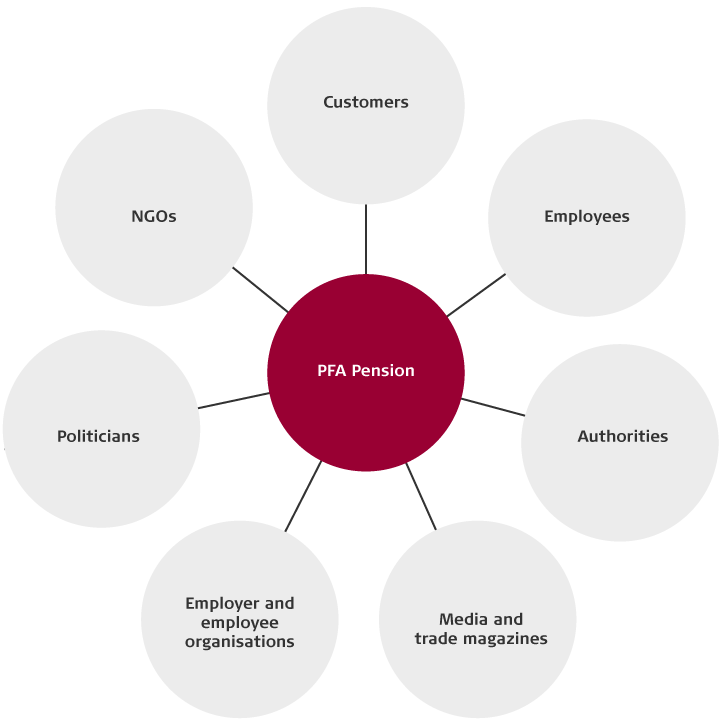
PFA represents an essential part of the Danish pension system and is one of the largest pension companies in Europe. This gives us the opportunity to contribute positively to finding solutions to several of the common challenges we face in Denmark, Europe and globally. We are in constant dialogue with our customers, organisations, NGO’s, authorities, politicians, the media and a wide range of other stakeholders to create the best possible conditions for, among other things, financial security in Denmark and to help find solutions to common challenges. We believe that long-term and mutually beneficial cooperation based on transparency and trust generate the best results. We are very pleased with the cooperation we have with our customers in, among other things, the Youth Council, the Customer Council and the Senior Customer Council.

Open dialogue is important to us, and we contribute, among other things, through market surveys, analyses, comments and opinion pieces that shed light on matters relating to savings, insurance, prevention, health and climate.

We aim to focus our efforts on the areas where we can make the greatest difference. We therefore have a particular focus on collaborations and partnerships within: Financial security, Health, A good Senior Life, the Green transition and Security. Read more about our collaborations and partnerships under each of the five focus areas. 

Stakeholders - PFA Pension 

Suppliers

At PFA we have requirements for our suppliers

Good supplier management is an important part of reducing the overall footprint from PFA’s business and ensuring that we live up to international principles for corporate responsibility. We are committed to complying with international guidelines, standards and frameworks for sustainability, including the UN Global Compact’s 10 principles, the UN Guiding Principles on Business and Human Rights and the OECD Guidelines for Responsible Business Conduct, including the ILO conventions on fundamental labour rights and the UN Universal Declaration of Human Rights.

We expect our suppliers to be able to account for their work relating to human rights, climate and environment, including the considerations they have made to avoid negative impacts and the management systems they use to ensure this.

Responsible corporate practices are important

Specifically, when entering into contracts and throughout the contractual relationship, we require our suppliers to have responsible business practices in relation to, among other things, child labour, discrimination, forced labour, working environment, privacy, corruption and environment and climate. The requirements are set out in a so-called Code of Conduct, which gives PFA the option to carry out inspections at suppliers and to terminate the contract in the event of a breach.

An area in constant development

Responsible supplier management is constantly evolving, and new rules are regularly being introduced. In particular, requirements for sustainability reporting and IT security impose stricter demands on how companies obtain data from their suppliers and report on it. This is positive, as it means that at PFA we will to a much greater extent be able to obtain information about our suppliers on an ongoing, automated and standardised basis.

It is a major task for our suppliers, and many are well underway with the work, but it is also something that takes time. At PFA we therefore regularly update our methodology, processes and governance for follow-up with our suppliers. We are in ongoing dialogue with our suppliers, both large and small, as well as relevant industry organisations to ensure that the necessary initiatives are put in place so that we reach our target in a responsible way and, along with our suppliers, live up to our shared corporate responsibility.