Markets in holding pattern after conflicting statements
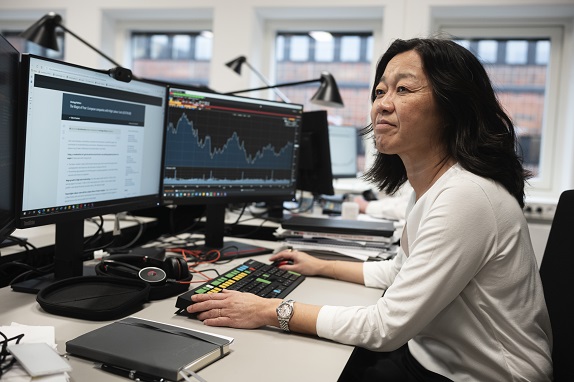
The conflict with Iran and renewed upward pressure on interest rates are shaping global financial markets. Although President Trump has reported progress in the negotiations and postponed his threatened military offensive, uncertainty remains high as Tehran has subsequently denied that there has been any dialogue between the parties.
Recent weeks have been characterised by pronounced fluctuations in the financial markets, driven by changing messages about the prospects of a solution to the conflict with Iran. Yesterday Trump stated that negotiations with Iran were progressing well, after which Iran shortly afterwards rejected the statement. Nonetheless, the message was received positively, as the markets, despite the confusion, interpreted it as a step towards de-escalation.
According to PFA’s Chief Strategist, Tine Choi Danielsen, developments show how sensitive the markets are to geopolitical risks at the moment.
“We are seeing a market that reacts promptly to political statements. The longer the conflict is expected to drag on, the more negative the reactions become. Iran’s rejection of Trump’s version of events has at the same time increased uncertainty about what is actually going on. We must therefore expect a certain degree of volatility in the financial markets for some time yet,” she says.
Déjà vu: Will interest rates again be the big game changer?
Alongside the geopolitical tensions, interest rates have once again started to rise as a result of increasing economic uncertainty. This increases the USA’s already large debt burden and reduces the fiscal room for manoeuvre of the US administration, as ongoing interest expenses rise.
“The yield on the 10-year US government bond has passed 4.40 per cent and is thereby approaching 4.60 per cent, which constituted the economic pain threshold during last spring’s trade war. It was precisely this level that at the time prompted the Trump administration temporarily to suspend some of the increased tariffs,” explains Tine Choi Danielsen.
She will therefore not rule out that the interest rate increases of recent days may have played a role in the political deliberations about seeking a negotiated solution rather than a military escalation.
Stay calm and focus on long-term developments
The conflict has already clearly been reflected in oil prices and also threatens the supply of fertiliser and other key commodities. Nevertheless, market reactions have so far been relatively contained. At PFA we are following developments closely.
“Because of the unsettled situation we at PFA have chosen to reduce equity risk in order to protect customers’ savings. Our recommendation remains that, as an investor, you stay calm and do not trade in panic on the basis of the daily headlines. Looking at a slightly longer horizon, the five-year return is still around 40-45 per cent and in recent years we have seen many examples of how quickly markets can recover,” says Tine Choi Danielsen.
She points out that global equity markets are in negative territory this year, and that the consequences so far have been greatest for the Asian markets because they are most dependent on the Strait of Hormuz remaining open. Europe is also energy dependent, but obtains a smaller share of its energy via Hormuz.