Hot labour market and Middle East stalemate halt equity rally
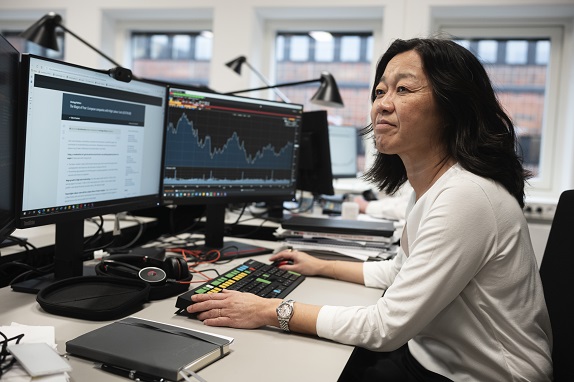
A surprisingly strong US labour market, stubborn inflation and lack of progress in the Middle East have in recent days put an end to the equity rally of the past few months. However, this does not change the fact that returns for the year as a whole still look solid. A typical PFA customer can currently enjoy an return of around 6 per cent since the turn of the year, while the three-year return stands at 40 per cent. So says PFA’s Chief Strategist, Tine Choi Danielsen, who is also looking ahead to the stock market listing of SpaceX at the end of the week, which is shaping up to be one of the largest in history.
Equity markets took a marked dive on Friday, thereby putting an end to the equity rally and record prices of recent months. The reason was a cocktail of an unexpectedly hot US labour market and inflation that appears to have become entrenched. According to Tine Choi Danielsen, the consequence is clear: the prospect of interest rate cuts has been replaced by a risk of interest rate hikes.
“The US central bank has a dual mandate to ensure stable employment and low inflation. While the first appears to be in order, the second is proving more difficult. It is therefore now more realistic to expect rate hikes than rate cuts for the remainder of the year. Combined with the lack of progress in the Middle East, this helped send equities lower,” she says about the development, where the S&P 500 ended with a decline of 1.87 per cent in DKK terms, while the tech‑heavy Nasdaq index fell by as much as 3.42 per cent in DKK terms.
Strong employment is a double‑edged sword
Despite the market reaction, the strong employment figures are not all bad news. Low unemployment helps keep growth going – private consumption accounts for around 70 per cent of US gross domestic product, and in real‑economic terms the report is therefore not unequivocally negative. According to the Chief Strategist, however, it hits equities because much of companies’ value rests on expectations of future earnings. This applies not least to the fast‑rising growth stocks in the tech sector, which also fell the most during Friday’s sell‑off.
“It is entirely natural that tech stocks take the biggest hit, as they also flew highest during the upswing. They are also particularly sensitive to high interest rates because their valuation depends to a special degree on expectations of future earnings, which fall in present value when interest rates rise. Although it was a large drop, the picture for the year as a whole still looks good. The S&P 500 index is holding on to an increase of 10.5 per cent in DKK terms, while Nasdaq has delivered a return of 13.6 per cent in DKK terms year to date,” says Tine Choi Danielsen.
Historic stock market listing indicates a trend
Looking at the tech sector, one of the world’s largest stock market listings is imminent when Elon Musk’s SpaceX is scheduled to go public on 12 June. However, this will take place in stages, which limits the immediate impact on the wider market. Only around 4 per cent of the shares will be offered for sale initially, and it is solely the value of these freely traded shares that will determine the company’s initial index weight in indices such as Nasdaq or the S&P 500.
Nevertheless, the listing of SpaceX will be exciting to follow, as it also marks the beginning of a broader trend and will not stand alone. Leading AI companies such as OpenAI and Anthropic likewise plan stock market listings over the coming year, while Google’s parent company Alphabet has just opened the door to a major share issue.
“Tech companies are increasingly seeking to raise new capital because forward‑looking investments in artificial intelligence, data centres and global logistics have become enormous and capital‑intensive – even though the companies continue to make good money. The massive multi‑billion investments create growth and increased productivity in society, but they can of course also put pressure on companies’ earnings and share prices if their ambitious bets on the future and future technology do not pay off,” says Tine Choi Danielsen.
Stock market listings: recent examples give a mixed picture
According to the Chief Strategist, we have for many years not been spoilt with gigantic stock market listings. The most recent large comparable listing was in 2014 with Chinese company Alibaba, whose journey has been uneven and which today has a market value that is half of its peak in 2020. The picture is more encouraging for US giants Amazon and Alphabet (Google), which since their listings in 1997 and 2004 have delivered returns to investors of more than 300,000 per cent and 12,000 per cent respectively in DKK terms.
Although each company must be assessed as an investment case in its own right, it is generally positive that, through stock market listings, we can share in the long‑term value creation that takes place in companies:
“As is well known, historical returns are no guarantee of future ones, and each company is different. But in general it is positive that companies are listed on the stock exchange so that we all gain access to their long‑term value creation. This has certainly been the case for Danish pension savers, who have benefited from being invested in the US. Looking at the S&P 500 index, it has risen by more than 240 per cent in DKK terms over the past ten years, and through their pension savings in particular, people in Denmark have enjoyed a good share of this massive value creation,” concludes Tine Choi Danielsen.